Industrial Laser Safety Technician Certification
What Does Industrial Laser Operator Certification Mean?
Industrial laser operator certification documents that a person has completed education and an assessment covering general laser hazards, classifications, and control measures.
Certification does not independently authorize someone to operate a particular laser or replace employer-provided equipment-specific instruction, practical evaluation, and authorization.
Industrial Technician Certification – $69
Through our Industrial Laser Safety Curriculum, your employees will learn everything they need to know about the following:
- How lasers work
- Why wavelength is important
- Personal Protective Equipment
- Non-ionizing radiation
- Laser Hazard Classes
- Beam contact hazards
Looking for course details and enrollment information? View our Industrial Laser Safety Technician Certification course
Being “laser certified” in the context of Industrial Laser Safety Technician/Operator Certification means that an individual has completed specific training and certification processes to ensure they have the knowledge and skills necessary to safely operate and manage laser systems in an industrial setting. This certification validates that the person understands the potential hazards associated with laser use and is competent in implementing safety protocols to mitigate these risks. Here’s what it typically entails:
What Does Industrial Laser Operator Certification Cover?
Standards and Employer Responsibilities
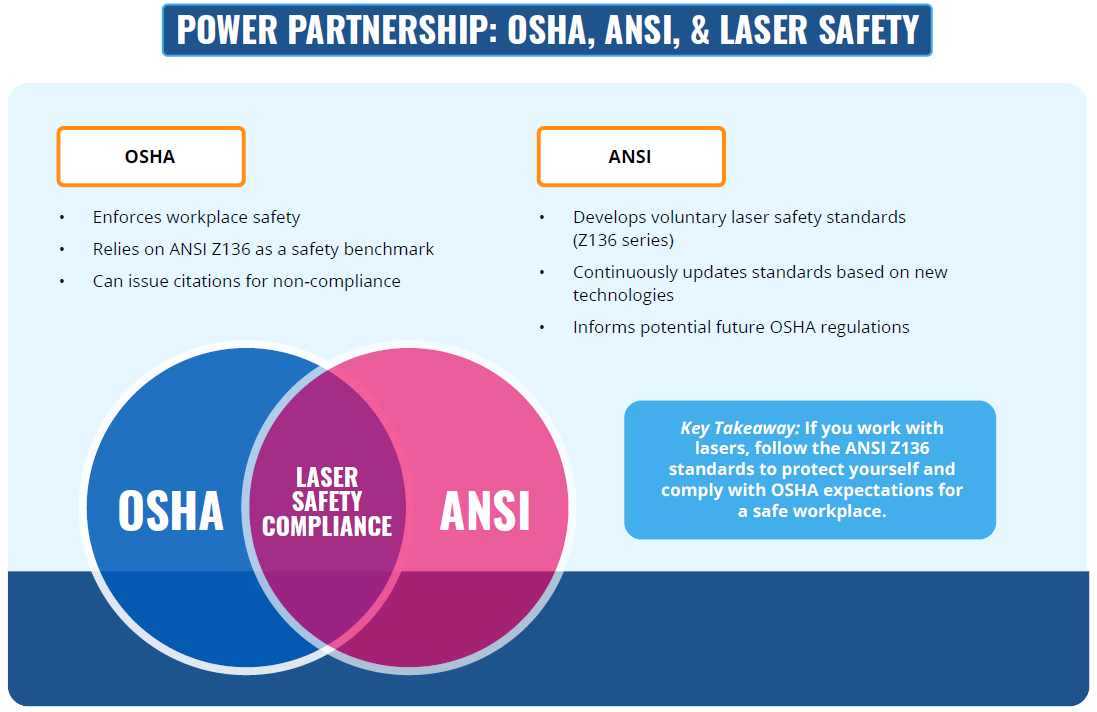
Industrial laser safety programs may be informed by applicable OSHA requirements and ANSI Z136.1 guidance. ANSI Z136.1 addresses laser classifications, hazard evaluation, control measures, and program responsibilities.
Certification can support an employer’s laser safety program, but it does not independently establish OSHA compliance. Employers remain responsible for evaluating their equipment and work, implementing appropriate controls, providing equipment- and task-specific instruction, authorizing personnel, and maintaining required records.
How Does Industrial Laser Operator Certification Work?
How to get certified for laser safety
Certification Benefits
Why it is important to become laser safety certified
Responsibilities of Certified Technicians/Operators
What is your role after becoming certified?
Operation and Maintenance:
- Safely operate and maintain industrial laser systems according to manufacturer guidelines and safety standards.
- Perform regular inspections and maintenance to ensure the equipment is functioning safely and efficiently.
Safety Implementation:
- Implement and enforce safety protocols, including the use of PPE and engineering controls.
- Conduct hazard evaluations and update control measures as necessary.
Training and Supervision:
- Provide laser safety training to new operators and ensure ongoing education for existing staff.
- Supervise the use of laser systems to ensure compliance with safety procedures.
Incident Management:
- Respond to laser-related incidents, conduct investigations, and implement corrective actions to prevent future occurrences.
Is Industrial Laser Operator Certification Enough to Operate a Laser?
Industrial laser operator certification provides a foundation in laser hazards and controls, but certification alone does not authorize operation of every laser system.
The employer must supplement general certification with instruction, evaluation, procedures, controls, and authorization appropriate to the facility’s equipment and the employee’s assigned tasks.
Technical Review
Developed and reviewed by Nate Wilkerson for laser safety and certification accuracy. Content is based on applicable ANSI Z136.1 guidance and OSHA laser-hazard resources.
Last reviewed: September 7, 2026. To report a correction, contact info@lasersafetycertification.com.