OSHA Accident Investigation for Laser Safety
OSHA Accident Investigation: Laser Safety, Near Misses, and Root Cause Analysis
Laser incidents can happen quickly, but the causes often build over time. A missing warning sign, incorrect eyewear, poor alignment procedure, unsecured controlled area, incomplete training, or weak supervision can all lead to a serious exposure event.
That is why accident investigation is an important part of any laser safety program. After a laser incident or near miss, employers should look beyond what happened and ask why it happened. The goal is not to blame one person. The goal is to find the root cause, correct the hazard, and prevent the same problem from happening again.
For facilities that use Class 3B or Class 4 lasers, strong laser safety depends on training, hazard controls, proper documentation, emergency response procedures, and a functioning Laser Safety Officer program. LaserSafetyCertification.com helps employers provide foundational laser safety training for operators, technicians, and Laser Safety Officers.
Regulatory Requirements for Laser Safety
OSHA requires employers to provide a workplace free from recognized hazards. For laser hazards, this means employers must identify laser risks, train affected workers, use appropriate control measures, and maintain a safe work environment.
OSHA does not approve or certify private laser safety training providers. Instead, employers are responsible for choosing training that supports their safety obligations and aligns with recognized safety practices. In the United States, laser safety programs commonly rely on the ANSI Z136 series of standards.
LaserSafetyCertification.com courses are designed around ANSI Z136.1 for industrial and laboratory laser environments and ANSI Z136.3 for healthcare, medical, cosmetic, and veterinary laser settings. These standards help define laser classifications, control measures, Laser Safety Officer responsibilities, training expectations, hazard evaluation, and safe work practices.
It is also important to understand what a course certificate means. LSC provides certificates of completion for foundational laser safety training. These certificates help document that training was provided, but they are not the same as professional CLSO or CMLSO credentials issued by the Board of Laser Safety.
Best Practices for Laser Accident Prevention
The best laser accident investigation is the one you never need to conduct. Strong prevention practices reduce the chance of eye injuries, skin exposure, fires, plume hazards, electrical hazards, and unsafe laser operation.
Important laser safety practices include:
- Laser hazard evaluation: Facilities should understand the laser class, wavelength, power, beam path, exposure risk, and required control measures.
- Laser Safety Officer oversight: Class 3B and Class 4 laser use should be supervised by a designated Laser Safety Officer or responsible safety lead.
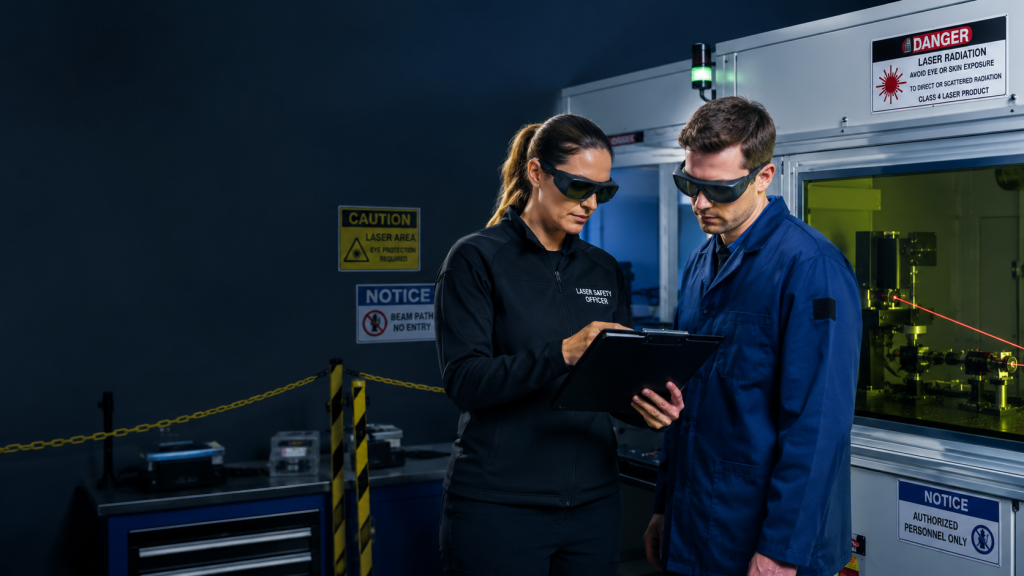
- Controlled areas: Laser areas should be marked, secured, and managed so unauthorized personnel are not exposed to hazardous beams.
- Proper eyewear: Workers should use eyewear matched to the laser wavelength and optical density requirements.
- Operator training: Laser users should understand hazards, warning signs, PPE, emergency procedures, and safe operating rules before working with or near lasers.
- Written procedures: Facilities should maintain standard operating procedures for normal use, alignment, maintenance, and emergency response.
Employers can support these practices with Industrial Laser Safety Officer training, healthcare laser safety training, and operator-level laser safety courses.
Common Laser Safety Hazards
Laser hazards are not always obvious to untrained workers. Invisible beams, reflected energy, incorrect eyewear, and poor procedural controls can create serious risks before anyone realizes something is wrong.
Common laser safety hazards include:
- Eye exposure: Direct, reflected, or scattered laser radiation can injure the retina or cornea, depending on wavelength and exposure conditions.
- Skin exposure: High-powered lasers can cause burns or tissue damage.
- Specular reflections: Mirrors, tools, jewelry, instruments, and shiny surfaces can redirect hazardous beams.
- Alignment hazards: Beam alignment often creates higher risk because guards or enclosures may be opened and beams may be exposed.
- Incorrect eyewear: Eyewear must be appropriate for the wavelength and optical density needed for the laser in use.
- Laser plume: Medical, cosmetic, and industrial laser processes may generate smoke, vapor, particulates, or biological contaminants.
- Electrical and fire hazards: Laser systems may involve high voltage, cooling systems, flammable materials, and ignition risks.
Recognizing these hazards is the first step. The next step is using training, procedures, PPE, controls, supervision, and corrective action to reduce risk.
What Are the Essential Steps in a Laser Accident Investigation?
A strong laser accident investigation should be organized, timely, and focused on facts. The purpose is to understand what happened, why it happened, and what must change to prevent recurrence.
After a laser incident or serious near miss, employers should follow these basic steps:
- Respond to the emergency: Make sure affected workers receive medical attention when needed and the area is safe.
- Stop laser operation: Shut down or secure the laser system if it can be done safely.
- Secure the area: Keep unauthorized personnel away from the laser controlled area and preserve evidence when possible.
- Collect information: Take photos, gather witness statements, review laser settings, inspect eyewear, check warning signs, and review training records.
- Identify root causes: Look beyond the immediate error and review procedures, supervision, equipment condition, PPE, training, and controlled area setup.
- Take corrective action: Update procedures, retrain workers, repair equipment, improve signage, revise eyewear selection, or strengthen LSO oversight.
- Follow up: Confirm corrective actions were completed and actually reduced the hazard.
How to Conduct Root Cause Analysis for Laser Safety Incidents
Root cause analysis, often called RCA analysis, helps employers identify the deeper reasons an incident occurred. Instead of stopping at “the operator made a mistake,” RCA asks what conditions allowed the mistake to happen.
For example, a technician may experience a near miss during beam alignment because a protective housing was open. But root cause analysis may reveal deeper issues, such as unclear alignment procedures, missing temporary barriers, poor LSO review, incorrect eyewear, production pressure, or incomplete training.
Common RCA tools include:
- 5 Whys analysis: Asking “why” several times to uncover the deeper cause of a problem.
- Fishbone analysis: Also called fish bone analysis or RCA fishbone, this tool organizes possible causes into categories such as people, equipment, environment, process, and training.
- Incident trend review: Looking at past laser incidents, near misses, eyewear problems, procedural deviations, and maintenance reports to identify repeated patterns.
The RCA process should lead to corrective actions that are specific, practical, documented, and verified.
What OSHA Standards Apply to Laser Accident Investigations?
OSHA does not have one single “laser accident investigation standard” that covers every possible situation. Instead, several OSHA rules and principles may apply depending on the incident, workplace, laser system, and injury outcome.
Employers should understand OSHA’s General Duty Clause, injury reporting requirements, recordkeeping rules, PPE requirements, electrical safety rules, hazard communication requirements, and emergency response expectations. OSHA also references recognized laser safety guidance, including ANSI laser safety standards, when evaluating laser hazard controls.
For laser safety programs, ANSI Z136.1 and ANSI Z136.3 are especially important. ANSI Z136.1 applies broadly to safe laser use in industrial, research, and laboratory environments. ANSI Z136.3 applies to laser use in healthcare and related clinical environments.
How Emergency Response Procedures Support Laser Accident Investigations
Emergency response procedures protect workers immediately after a laser incident. They also help preserve important information for the investigation.
A strong emergency action plan should explain what employees need to do during an emergency. This may include who to notify, how to shut down the laser, how to get medical help, how to preserve the scene, and how to keep others away from danger.
For laser incidents, emergency preparedness and response may include:
- Stopping laser operation when safe
- Checking for eye, skin, burn, smoke, electrical, or fire exposure
- Calling emergency medical services when needed
- Referring workers for medical evaluation after suspected eye exposure
- Securing the laser controlled area
- Preserving eyewear, settings, logs, signage, and procedural records
- Notifying the Laser Safety Officer, supervisor, and safety personnel
Emergency response should never put additional workers in danger. Employees should only act within their training and should call professional emergency services when needed.
Key Emergency Response Steps After a Laser Incident
After a laser accident or serious near miss, supervisors and LSOs should act quickly but carefully.
Key steps include:
- Assess the situation: Look for ongoing hazards such as active beams, exposed optics, smoke, fire, electrical hazards, or unsafe equipment conditions.
- Stop exposure: Shut down or secure the laser system if it can be done safely.
- Get medical help: Arrange medical evaluation for suspected eye exposure, burns, inhalation exposure, or other injuries.
- Secure the area: Keep unauthorized personnel out of the laser controlled area until the scene is safe.
- Report the incident: Notify the Laser Safety Officer, management, safety personnel, and any required outside agencies.
- Begin documentation: Record what happened while details are still fresh.
These steps support both worker safety and the accident investigation process.
Why Near Miss Reporting Is Critical in Laser Safety
A near miss is an event that could have caused injury, damage, or loss, but did not. Near misses are warnings. When employers take them seriously, they can correct hazards before someone gets hurt.
Near miss reporting is especially important in laser safety because many warning signs occur before a serious exposure. A worker entering a controlled area without eyewear, a reflected beam appearing outside the expected path, an unlocked laser room, or a missing warning sign should all be treated as useful safety information.
Near miss reporting helps employers:
- Find hazards before injuries occur
- Improve emergency response procedures
- Identify training gaps
- Strengthen LSO oversight
- Improve PPE and eyewear practices
- Update standard operating procedures
- Prevent repeat incidents
A near miss may also show that workers need refresher training, improved signage, stronger access control, better eyewear selection, or more detailed procedures.
What Defines a Near Miss in Laser Safety?
In laser safety, a near miss is any event that had the potential to cause harm but did not result in injury or damage.
Examples include:
- A worker entering a laser controlled area without proper eyewear
- A beam reflection leaving the intended beam path
- A laser warning sign missing from an active laser area
- An alignment procedure performed without required controls
- Incorrect eyewear discovered before laser operation begins
- A protective housing, interlock, or barrier found damaged before use
- Smoke or plume exposure noticed before workers report symptoms
Even if no one is hurt, the incident should still be reported, reviewed, and corrected.
How to Implement Near Miss Reporting Guidelines
Near miss reporting only works when employees feel safe speaking up. If workers think they will be punished for reporting a close call, they may stay quiet. That allows hazards to remain in place.
Effective near miss reporting should include:
- Simple reporting steps: Make it easy for laser users to report hazards, incidents, and close calls.
- No-blame culture: Focus on correcting hazards, not punishing honest reporting.
- Fast LSO review: The Laser Safety Officer or safety lead should review reports promptly.
- Trend analysis: Look for repeated problems involving eyewear, access control, alignment, signage, or procedures.
- Employee feedback: Let workers know what changed because of their report.
A strong reporting system turns near misses into practical safety data.
How Laser Safety Training Supports Accident Prevention
Laser safety training helps prevent accidents by making sure workers understand laser hazards, control measures, PPE, warning signs, emergency response, and safe operating procedures before they begin work.
Training should cover both general laser safety and workplace-specific hazards. That includes laser classification, wavelength, beam hazards, non-beam hazards, eyewear, controlled areas, signage, administrative controls, and emergency procedures.
LaserSafetyCertification.com provides foundational laser safety training designed to help employers train operators, technicians, and Laser Safety Officers. Courses are available for industrial, laboratory, healthcare, cosmetic, and veterinary laser environments.
What Are the Benefits of Laser Safety Training?
Laser safety training benefits both employers and workers.
Key benefits include:
- Better hazard awareness: Workers learn how laser injuries happen and how to avoid them.
- Stronger documentation: Employers can maintain records showing that laser safety training was provided.
- Better PPE use: Workers learn why wavelength and optical density matter when selecting laser eyewear.
- Improved investigations: Training records help employers review whether instruction gaps contributed to an incident.
- Stronger LSO programs: Laser Safety Officers gain a clearer framework for oversight, procedures, and corrective action.
- Reduced risk: Trained workers are more likely to recognize hazards and follow safe procedures.
How Often Should Laser Safety Training Be Refreshed?
Laser safety training should be refreshed when risk changes, when procedures change, when new laser equipment is introduced, or when an incident or near miss shows that workers need additional instruction.
Refresher training may be needed when:
- A worker is involved in a laser incident
- A worker is involved in a laser near miss
- Workers are observed using unsafe procedures
- Laser equipment, wavelength, power, or application changes
- Eyewear, barriers, signage, or controlled area procedures change
- A new Laser Safety Officer is assigned
- Workplace conditions change in a way that affects safe laser use
Accident investigations should always include a review of training history, LSO oversight, standard operating procedures, PPE selection, and any previous near miss reports.
How the Laser Safety Officer Supports Accident Investigation
The Laser Safety Officer plays a central role in preventing and investigating laser incidents. In many facilities, the LSO is responsible for helping evaluate hazards, recommending control measures, reviewing procedures, training workers, and maintaining records.
During a laser accident investigation, the LSO may help review:
- Laser classification and operating parameters
- Beam path and possible reflection points
- Eyewear selection and availability
- Controlled area setup and warning signs
- Written standard operating procedures
- Training records and worker authorization
- Medical response and follow-up documentation
- Corrective actions and future prevention steps
For workers assigned to manage laser safety programs, Laser Safety Officer training can provide a practical foundation for understanding LSO responsibilities, hazard controls, and documentation.
Frequently Asked Questions
What is the role of OSHA in laser safety?
OSHA enforces workplace safety requirements and expects employers to protect workers from recognized hazards, including laser hazards. OSHA does not approve private laser safety courses, but employers may use training based on recognized standards such as ANSI Z136.
What standards apply to laser safety programs?
Laser safety programs commonly rely on the ANSI Z136 series. ANSI Z136.1 applies broadly to industrial, research, and laboratory laser use. ANSI Z136.3 applies to healthcare and medical laser environments.
What are common causes of laser safety incidents?
Common causes include incorrect eyewear, poor beam control, missing signs, unsecured controlled areas, unsafe alignment procedures, reflected beams, weak training, and lack of LSO oversight.
How does near miss reporting improve laser safety?
Near miss reporting helps employers find hazards before they cause injuries. It also helps identify trends, improve training, update procedures, and support corrective action.
What should be included in a laser safety training program?
Laser safety training should cover laser hazards, classifications, beam and non-beam hazards, PPE, eyewear, controlled areas, warning signs, emergency procedures, and workplace-specific procedures.
How can root cause analysis improve laser safety?
Root cause analysis helps employers find the deeper reasons an incident happened. By correcting root causes, facilities can reduce the chance of repeat laser incidents.
Is a laser safety course certificate the same as CLSO or CMLSO certification?
No. A course certificate documents completion of training. CLSO and CMLSO are professional credentials issued by the Board of Laser Safety and involve separate eligibility and examination requirements.
What should an emergency response plan include for laser incidents?
An emergency response plan should explain how to stop laser operation, get medical help, secure the controlled area, notify the Laser Safety Officer, preserve evidence, and document the incident.
Conclusion
Laser accident investigation is about prevention. When employers investigate laser incidents and near misses, they gain information that can help prevent future injuries.
A strong laser safety program should include training, LSO oversight, PPE, controlled areas, written procedures, emergency response, near miss reporting, root cause analysis, and corrective action. These steps work together to reduce risk and protect workers.
LaserSafetyCertification.com helps employers provide foundational laser safety training for operators, technicians, and Laser Safety Officers. If your facility uses industrial, laboratory, medical, cosmetic, or veterinary lasers, proper training and documentation are key parts of preventing incidents before they happen.