Laser Cleaning – Essential Safety SOP
Let’s talk about laser cleaning safety today. I think this is a really important topic for our customers. We have a lot of questions from people calling in and asking about what the right procedures are, what the right protection is for laser cleaning devices, and so I figured I would walk through some of the details that I’m aware of that I think are best practices that I think everyone should follow if they’re working with these devices, because they’re really powerful and therefore they have the potential to be quite dangerous.
Personal Protective Equipment for Laser Cleaning Machines
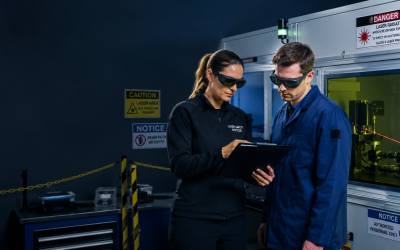
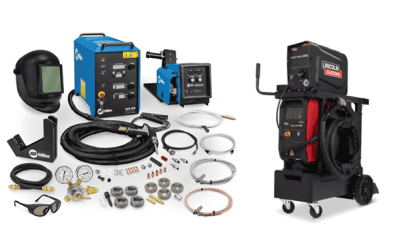
The first section we’re going to talk about for laser cleaning safety is appropriate personal protective equipment. It’s really important that you have the right eyewear for these laser cleaners. There are a lot of options out there. What we’re looking at right now are laser welding hoods with ventilators, and these are a good option.
You want to make sure that they’re rated for the wavelength that your laser device is outputting. For example, this one is a Miller non-laser welding helmet with internal ventilation. This is a great architecture because you have a transparent visor, a shielded visor, and then an in- integrated respirator.
That’s definitely the type of PPE that I would prefer. However, lasers do not output the same wavelength as regular welders, whether that’s ARC, MIG or TIG. You want to make sure that you have a laser helmet that is rated at the correct wavelength. You can see this has an optical density rating of eight at 1,000 nanometers and OD10 at 1064 nm, which is near infrared.
The thing that I like about this is this offers you full eye protection and breathing protection all in one device. This is rated for laser-welders and laser-cleaners to make sure that you have clean airflow to your lungs and that your eyes are protected, which is super critical.
The other thing that you could use is a combination of PPEs. For example, this 3M back-mounted respirator is a really great option because you can see there’s room in here to fit laser safety goggles. So if you wanted to use this, this is probably the best respirator that you can get, and then you can get, in addition to that respirator, laser safety goggles that are specified for your wavelength.
My favorite resource for laser safety goggles is Thorlabs. They make really great goggles. They’re really high quality, they last a long time, they’re comfortable, and most importantly, their specifications are very precise, so you know exactly what you’re getting when it comes to optical density rating at your use case wavelength. That’s the most important thing
Laser Cleaning Device Specifications
Let’s talk about the machines themselves. These days, almost everything is made overseas, so that might be unavoidable if you’re getting into this industry of laser cleaning, you’re probably going to buy a device made overseas. But the most important thing is that the device that you select comes with a spec sheet. You want to make sure that it’s not a mystery what wavelength and what power rating your laser cleaning device is outputting. So this is a really great example of a high-power laser cleaning machine with a really great fiber wand at the end. You can see the non-English characters on this device. It’s definitely made overseas.
If you’re the LSO, there are certain things that you should document in your own internal laser safety program and make sure that your spec sheet actually does specify them. The most important two metrics are wavelength and power output. Then if you drill down into those specs, you get pulse energy, pulse duration, pulse repetition frequency, beam diameter, and divergence.
You can also learn the focal length and scanning field. That way you know how far away your fiber wand can be from the workpiece before you start to have stray light going in unintended directions. You want to make sure that the manufacturer provides a laser hazard classification according to ANSI specs, so that’s Class 1 through Class 4. That’s the American standard.
If it’s not labeled at all, you know it might be a little bit more dangerous than you think. Ideally, your device should come with laser safety goggles so that there’s no mystery about which PPE you should use so you don’t have to hunt around online. But if you ever don’t know which PPE to use, you can always reach out to us and we will point you in the right direction and recommend goggles that are rated for your wavelength and power rating.
Nominal Hazard Zone
The other important thing to think about is the nominal hazard zone associated with your device. If you have any questions about that, we have a link on our website for nominal hazard zone calculators and how to do those calculations if you’re the LSO. If you reach out to us, we’re happy to do it for you as well.
When it comes to work piece laser cleaning, different materials have different reflective properties, and it’s really important that you’re aware of what type of reflections your workpiece is going to emit. For example, a really rough surface that you’re cleaning is going to have diffuse reflection where the light is scattered everywhere, and a really smooth material is going to have specular reflection where the light is scattered primarily in one singular direction. And that’s going to affect how you think about shielding from observers or other workers nearby, or if you’re outdoors, bystanders.
You want to be careful about where your reflections are going and make sure that they’re not going to blind anybody else. Because as the operator, you’re looking directly at the most dangerous part of the laser output, but people standing nearby could get secondary reflections that are just as dangerous as the ones that you’re looking at as the operator.
Laser Control Area
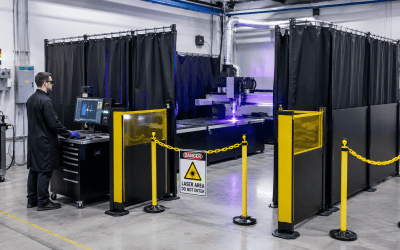
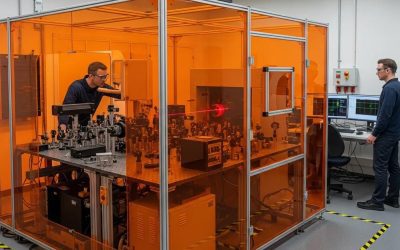
The next thing we’re going to talk about is proper enclosures and ventilation. If budget permits, I would definitely recommend getting a laser cleaning hood or laser welding enclosure. There’s a bunch of great options for that. This is a really great laser enclosure that you can walk into and fit large work pieces as well as your laser device. If you’re working in a warehouse or industrial manufacturing facility that has a big floor and you want to isolate all of the laser stray light from other workers who are not wearing laser safety goggles, this is a great option
If you don’t want to buy an entire enclosure, there are more cost-efficient options in the form of laser safety curtains and barriers. There are a ton of great manufacturers out there. This is one that I really like and you can specify the energy density in watts per square centimeters. If you have any questions about what your output energy density is for your specific device, you can give us a call and we’ll help you calculate it. Usually these are rated for Class 4 laser devices, and they’re perfect for mobile setups or temporary setups and large work areas with mobile devices and large work pieces.
You want to make sure that your laser safety barrier is specified for your wavelength and the energy density of your device. Then obviously, you never want to point an outgoing beam directly at the curtain material for an extended period of time.
The most important part of laser cleaning and laser welding is that reflections are the primary hazard. Pay special attention to polished stainless steel, aluminum, copper, brass, or galvanized surfaces. You also need to think about the material profile as including whether or not the workpiece is curved or cylindrical or concave, because that can either reflect, scatter, or focus the beam in unintended ways. You want to watch out for corners that can redirect the beam in unintended directions.
You also want to make sure that your workpiece is dry. If it is wet or oily, the laser beam is going to interact with that liquid, and it could cause off-gassing or burns or unintended reflections as well. Also be mindful of fixtures and clamps and work holding devices that you use.
Laser Cleaning Ventilation
The next most important thing to talk about is ventilation to capture fumes and particles at their source, because laser cleaning can vaporize, oxidize, fracture, or eject all sorts of gases. Common materials that can off-gas vapors, including paint and primer, rust, which is probably the most common use case for laser cleaning, oxidized surfaces, oils and greases. You want to watch out for adhesives and sealants. You want to watch out for plating and coating, whether it’s anodized or plated with a reflective material like nickel or chrome, and also the base material after it’s clean is going to off-gas a little bit as well. So just be mindful of anything that might be corrosive, anything that’s not the material that you’re cleaning, and capture it with local exhaust ventilation.
This is an industry standard device. They’re all over the place in industrial manufacturing facilities. If you have a good facilities manager, you could ask for them to install one in your facility that exhausts out of the roof of the building.
Alternatively, you could get an industrial air cleaner that is mobile, such as this one. This is a really great example And when you’re specifying this, you want to look at flow rate, which is measured in CFM, which stands for cubic feet per minute. You also want to look at specifications associated with the HEPA filter, like particle size, whether they can exhaust fire or smoke or gases or vapors or hazardous waste, and whether they have an alarm. You want to make sure you have lots of extra filters so you’re never having to work with a clogged filter.
You can also do exposure monitoring when you’re working on an unknown material or a material that you know to be particularly hazardous. Do not assume a visible plume is the only hazardous plume. A lot of the invisible ones are the most dangerous. You don’t want to get any carcinogenic flumes in your air in your work area, and especially not in your lungs.
Engineering & Procedural Controls
There are also certain best practices for machine guarding, whether that’s barriers, gates, fences around your work area, supervisors using the buddy system to have someone nearby. You can use a hold-to-run wand switch or EMO, which is an emergency machine off button. All serious industrial devices are equipped with these. They should look familiar, they should be prominent, and you should know where they are.
You can also use remote interlocks, integrated interlocks, beam attenuators, beam shutters, fiber connection strain reliefs, and handpiece storage cradles as well as engineering control measures and procedural control measures to prevent unintended operation.
It’s also a good idea to have documented SOPs. There’s one attached to this webpage, so you can have all of this written down and documented in your laser safety program if you ever get audited. That includes everything that we talked about in addition to fire prevention, electrical hazards, process controls.
The last thing I’ll say is the following; make sure you validate and document everything. In the eyes of OSHA, if you didn’t document it, it didn’t happen. So, hopefully that was quite helpful when it comes to laser cleaning safety. And if you have any questions, you’re welcome to reach out to us anytime.